
Leaving Home to Build a Home

Author: Ensi Qiao
The owner I thought I knew
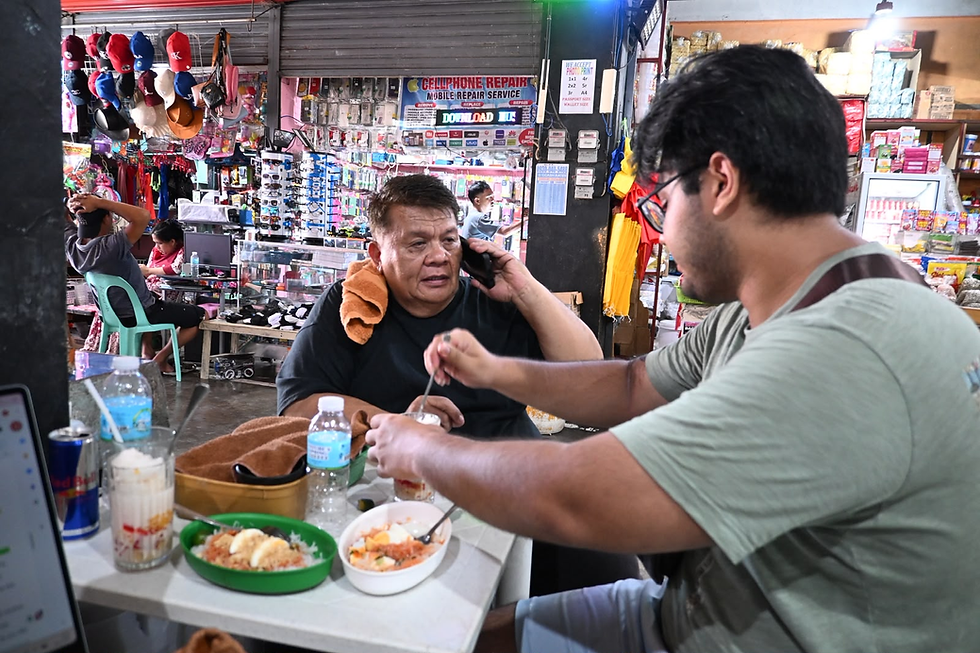
When I first met Joey at Jamila Bayron Snack Inn, I assumed that he had spent most of his life in Jagna.
He would be at the checkout area, monitoring the staff on his walkie-talkie, making transactions and greeting regulars as they passed by. Employees were carrying platters with puto maya, sikwate, pancit palabok and halo-halo down the tight market aisle.
On the surface, it seemed to be just a small, family run snack shop based on traditional snacks, an established customer base and the owners' work ethic.

That perception changed one afternoon when we left the market and went to a nearby park to talk. The park was not crowded, and Joey finally had enough time to sit across from us without being interrupted by customers or staff. Away from the noise of the stall, the conversation moved beyond products and sales. He began telling us about the life he had lived before Jamila Bayron Snack Inn.
Before the snack inn
Joey first worked in Mindanao as a medical representative, travelling across several provinces and promoting pharmaceutical products to doctors. He later moved into banking and spent approximately ten years at United Coconut Planters Bank.
After leaving the bank, Joey and his wife started a vegetable-noodle business. The Department of Science and Technology provided machinery and technical support, while Joey applied his experience in sales and marketing. The product entered the market, but the business itself was not financially sustainable.
The company lacked sufficient capital, retailers paid on credit, and Joey often had to rediscount post-dated cheques to obtain cash. At the same time, some workers allegedly sold noodles and cooking oil to neighbours without the owners’ knowledge. His story also reinforced a lesson from my own business experience: even a strong product can fail when employee controls and execution are weak.
Money from his wife’s bakery and beverage business was used to support the factory. Eventually, one struggling business pulled the others down. Joey and his wife became bankrupt and sold their house in Butuan to help repay their debts.
What surprised me was how casually he described the bankruptcy. He did not present it as the tragedy that defined his life. He explained what had gone wrong, almost as though he were analysing someone else’s business case.
Leaving the Philippines
The opportunity to work abroad came from an unexpected person.
During a conversation about their financial difficulties, Joey and his wife mentioned the idea of going overseas. One of their customers overheard them. He was not a relative, but he offered to borrow money through the Social Security System and lend the proceeds to Joey so he could look for work abroad.
In the UAE, Joey worked at Travelex and eventually became a store manager. His job involved attracting migrant labourers who needed to send earnings back to their families. However, the work was difficult. Competing money exchanges were often closer to the labour camps and offered better rates.
Life outside work was not comfortable either. Joey explained that although they earned money in dirhams, they also had to spend in dirhams. He enjoyed having his wife with him, but he never described Dubai as a permanent destination. There were debts to repay in the Philippines, but more importantly, a son growing up away from them.
Before speaking with Joey, I assumed that migrant workers would do almost anything to remain in a more developed country. I viewed migration mainly in terms of salary differences and personal opportunity. I thought that once someone had reached a country like the UAE, returning home would mean giving up a better life. Joey’s experience showed me that earning more abroad does not necessarily mean living better.
The reason to return
Joey’s only son, Paul, was studying in a seminary in Manila.
Paul eventually told his father that if he became a priest, he might not be able to work in a way that allowed him to care for Joey and his mother, Malo. He wanted to pursue a career outside the Church so that he could earn a living while still having time for his parents.
Joey was proud of Paul’s concern, but he was also worried.
At the time, Joey believed Bohol had serious problems involving drugs, violence and other negative influences. Paul had spent years in the controlled environment of the seminary, Joey therefore feared what might happen if his son suddenly entered a very different social environment without his parents nearby.
That concern made the decision final.
Joey and Malo returned to the Philippines, even though their financial position might have been stronger if they had remained abroad.

This was the point in the interview when my understanding of migrant workers changed the most. Joey’s story showed me that migration cannot be understood solely through higher salaries or personal opportunity. Many workers leave because they hope to build security for the families who remain at home.
Money sent home is only one part of that responsibility. Parents may also feel that their children need their presence, guidance and protection. A migrant worker can provide financially while still feeling that something important is being missed.
Joey left the Philippines to support his family, but he returned for the same reason.
Starting again
Before leaving the UAE, Joey and Malo began preparing for life in Jagna. Malo had learned baking and food preparation from her aunt ever since she was young. Her aunt later offered them the opportunity to manage one of her stalls in Jagna. They knew that several businesses already sold puto maya and sikwate, so they experimented with additional products. While still abroad, they used YouTube to study recipes and repeatedly tested arrozcaldo and pancit palabok with ingredients that would also be available in the Philippines. Jamila Bayron Snack Inn eventually became their new beginning.
What I will take with me
I still define success through achievement, financial security and the ability to build something valuable. Joey’s story did not replace that definition, but it broadened it.
Success is also the ability to recover when a business fails, to recognise an opportunity when it appears and to remain responsible for the people who depend on you.
Paul’s decision affected me personally. I want my own father to be able to speak proudly about something I have done for him—to say that his son was responsible and present when he was needed.
After this experience, I want to make three key changes. I want to understand people more deeply before forming assumptions about their abilities or backgrounds. I want to act when realistic opportunities arise instead of always staying within my comfort zone. Most importantly, I want to become more family-oriented and more conscious of my responsibilities as a son.
At the end of our conversation, Joey said:
“Whatever goodness you can do, and whatever kindness you can show, do it now, because we will never pass through this world again.”
Joey left home to rebuild his life. In the end, returning home was part of what he had been building all along.


Comments